Implementation of Passive Optical Networks (PON):Trends in the Development of PON-Based Networks
This article explores the implementation and evolution of Passive Optical Networks (PON), focusing on this technology's current state and future potential. It discusses the most widely used PON standards, GPON and EPON, along with trends shaping next-generation networks (NG-PON) aimed at enhancing bandwidth, coverage, and scalability. We’re covering the progression to higher-speed PON solutions, including 10G GPON, WDM-PON, and LR-PON, each suited to diverse deployment scenarios.
Page Contents
- Introduction to PON and Its Core Standards
- Key Benefits of PON Deployment
- NG-PON: Meeting Tomorrow’s Network Demands
- Advanced PON Solutions: 10G GPON and Beyond
- Takeaways
Introduction to PON and Its Core Standards
Overview of GPON and EPON Technologies
As of today, the most widespread types of PON are:
- Gigabit PON (GPON), an evolution of the previous BPON standard, uses a proprietary GEM encapsulation method at OSI Layer 2 to carry TDM and Ethernet traffic. The speeds provided are 2.48 or 1.24 Gbps downstream to the subscriber and 622 Mbps, 1.24, or 2.48 Gbps upstream from the subscriber to the OLT. For 32 ONTs, the bandwidth per subscriber may exceed 70 Mbps. Some implementations support up to 128 subscribers per fiber. GPON was standardized in 2003 under ITU-T G.984.1 and G.984.2.
- Ethernet PON (EPON), an IEEE 802.3ah (EFM) standard, using Ethernet frames with a symmetrical speed of 1 Gbps. The speed per subscriber is approximately 30 Mbps (with 32 ONTs). The communication range for both systems is standardized at about 20 km. EPON technology is prevalent across Asia, while GPON is more widespread in Europe and North America.

Key Benefits of PON Deployment
Major advantages of deploying PON networks include:
- only passive optical elements are used throughout the subscriber access network;
- a significant economy of cabling and space at the provider's base;
- reduced costs of operating the subscriber access network, specifically, lower power supply costs due to the elimination of active equipment across the distribution network and low maintenance costs owing to built-in operation and administration tools;
- ease of upgrading, scaling, and long service life of the access network.
NG-PON: Meeting Tomorrow’s Network Demands
Rationale for Development
Trends in the development of communication services indicate that, in a few years, the capabilities of current PON technologies may no longer meet operators' requirements. For this reason, leading manufacturers, in collaboration with operators, are actively working on the development and deployment of next-generation PON systems (NG-PON).
The primary goals of NG-PON development are to increase channel bit rate, expand coverage range, and raise the number of users that can be served within the network, while also addressing the issues of optimal transition from existing GPON or EPON to new NG-PON standards.
NG-PON1: Evolutionary Growth
The ITU-T and FSAN Group (Full Service Access Network – a consortium of 80 global operators, equipment manufacturers, and testing labs that develop optical network specifications) have identified two scenarios for NG-PON implementation. The first, termed NG-PON1, or “evolutionary growth,” envisions the coexistence of 1G-PON and NG-PON within a single Optical Distribution Network (ODN).
In this scenario, even if the operator later fully transitions to next-generation technology, it will still need to support or emulate 1G-PON for subscribers who remain satisfied with the previous generation’s service standards.
NG-PON2: Revolutionary Replacement
The second scenario – NG-PON2 or “revolutionary replacement” – involves a complete overhaul of the entire infrastructure, including the access network. This approach is ideal for operators building PON networks from scratch. Ultimately, this scenario may be used in the second stage of migration by companies already developing PON, as it offers the potential for even higher speeds.
Advanced PON Solutions: 10G GPON and Beyond
Let's take a look at the NG-PON solutions offered today.
10G GPON: Taking Connectivity to a New Level
To satisfy the ever-increasing appetite for increased bandwidth, current GPON systems are being upgraded to support 10 Gbps downstream speeds. These systems will be able to deliver over a thousand HDTV streams simultaneously, with extremely fast channel-switching times, thanks to the broadcast nature of PON. Additionally, the full suite of unicast personalized services may be be supported.
XG-PON1: The Stepping Stone
Currently, two options for GPON development exist: XG-PON1 and XG-PON2, where “X” represents the number “10.” The first option, standardized by ITU-T in 2010, allows data transmission at 10 Gbps downstream and 2.5 Gbps upstream. A number of recommendations from the G.987 family were adopted, setting out general requirements for XG-PON1, fiber optic network specifications, and transmission parameters, as well as G.988, which describes the management and administration interface for ONUs.
Today, XG-PON or XGS-PON standards (G.987.2 and IEEE 802.3 for the physical layer) are already available as an intermediate step toward implementing the NG-PON2 scenario (G.989.3)
The XG-PON network architecture comprises a single passive optical distribution segment (ODS) or a group of passive ODSs interconnected through RE. The optical configuration for XG-PON enables the simultaneous use of GPON and 10G-PON standards with the help of WDM filters and additional bandpass filters.
 Integration of wavelengths for GPON and 10G-PON standards with uplink and downlink data channels
XG-PON2: Continuing Evolution
The second version of the XG-PON2 standard is a symmetrical technology that enables 10 Gbps transmission in both directions. XG-PON2 systems are more costly, due to the requirement for more advanced pulsed lasers in subscriber devices to support high upstream speeds.
In XG-PON1, two new wavelength ranges have been introduced for signal transmission: 1575-1580 nm for downstream and 1260-1280 nm for upstream traffic. Since GPON signals are transmitted at other wavelengths, specifically 1480-1500 nm for upstream and a modified range of 1290-1330 nm for downstream as defined by recommendation G.987.2, GPON and XG-PON1 utilize non-overlapping frequency bands and can coexist on the same optical line without issues.
In the 10G-EPON standard, the situation becomes slightly more complex, as its wavelength range for downstream transmission overlaps with that of GEPON. Thus, to avoid interference between 10G-EPON and GEPON streams when transmitting over the same fiber, time division of signals at different speeds (“dual-speed TDMA”) is implemented.
WDM-PON: The Future of PON
The long-term future of PON lies in WDM-PON, which utilizes a dense wavelength division multiplexing (DWDM) grid to accommodate a large number of parallel high-speed channels over a single PON infrastructure. WDM-PON offers an alternative transmission scheme where each ONT transmits and receives data on a dedicated wavelength allocated to it.
In a typical WDM-PON architecture, passive splitters will be replaced by wavelength-selective filters, most commonly implemented as arrayed waveguide gratings (AWG). The deployment of WDM-PON is expected to boost access network transmission speeds to at least 40 Gbps downstream and 10 Gbps upstream.
NG-PON2, developed by the ITU in 2015, defines a new PON architecture capable of supporting a total network capacity of 40 Gbps through four symmetrical uplink/downlink wavelengths available to each subscriber. The NG-PON2 standard uniquely utilizes active tunable filters and tunable lasers installed in each ONU. This technology includes time wavelength division multiplexing passive optical networking (TWDM) PON, a type of passive optical network with both time and wavelength (spectral) multiplexing.
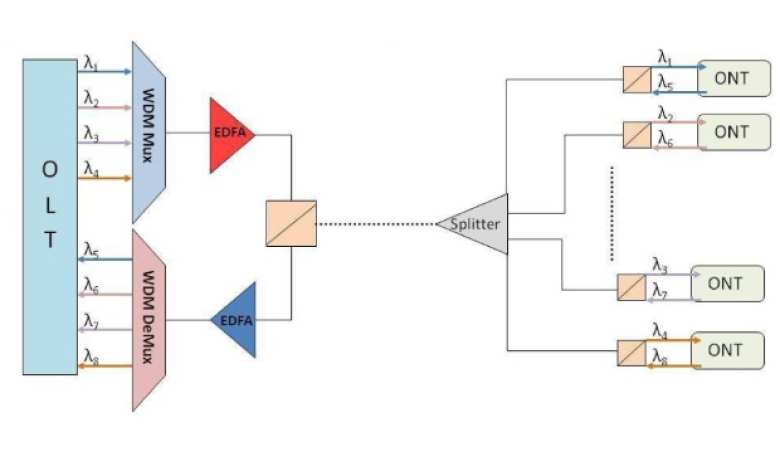
TWDM-PON: Combining Time and Wavelength Multiplexing
TWDM-PON technology uses four pairs of wavelengths in different spectral ranges to set up duplex communication channels. Wavelengths (λ1 - λ4) are allocated for upstream transmission, while wavelengths (λ5 - λ8) are designated for downstream transmission. In TWDM PON systems, three frequency bands can be used for stream transmission: 1270-1280/1570-1580 nm – the XG-PON band, 1535-1540/1553-1558 nm – the C-band, and 1535-1540/1570-1580 nm – the C+ L-band. Transmitting TWDM PON signals in the C-band and C+ L-band enables the use of erbium-doped fiber amplifier optical amplifiers (EDFAs), enhancing the optical budget of the link.
In addition to using a greater number of wavelengths for upstream and downstream transmission, TWDM PON also supports tunable optical transmitters (tunable Tx) and selective optical receivers (selective Rx) in both station and terminal equipment (OLT and ONU/ONT). Leveraging tunable components enables scaling and reconfiguring of TWDM PON networks at the hardware level without the need to re-lay passive transmission network components.
Along with flexible wavelength tuning, TWDM PON enables fine adjustment of the transmission rate within a single channel. It supports both symmetric communication channels at 10G/10G and 2.5G/2.5G, as well as asymmetric channels at 10G/2.5G.
LR-PON: Extending Reach for Remote Connectivity
LR-PON is a GPON with an extended range. Many operators are considering consolidating their points of presence to reduce access network operating costs. Thus, the option of GPON with extended range increases the area served by the operator from one point and eliminates the need for intermediate stations.
Potentially, the number of ONTs per OLT will also increase. We are talking about the size of the access network, which is estimated at tens of kilometers. For example, solutions based on the use of optical amplifiers to increase the optical budget can achieve a range of 60 km. This, for example, makes it possible to provide communication services to remote rural areas without deploying operator's points of presence there, which significantly reduces operating costs.
Takeaways
The evolution of PON technology represents a critical shift in providing high-capacity, reliable, and efficient access networks. From GPON and EPON to NG-PON, WDM-PON, and LR-PON, each standard offers unique strengths suited to varying deployment environments. These innovations not only support growing data transmission demands but also pave the way for sustainable network expansion in urban, suburban, and even remote rural areas. As operators adopt these advanced PON solutions, the potential for more inclusive and scalable digital connectivity becomes increasingly attainable.